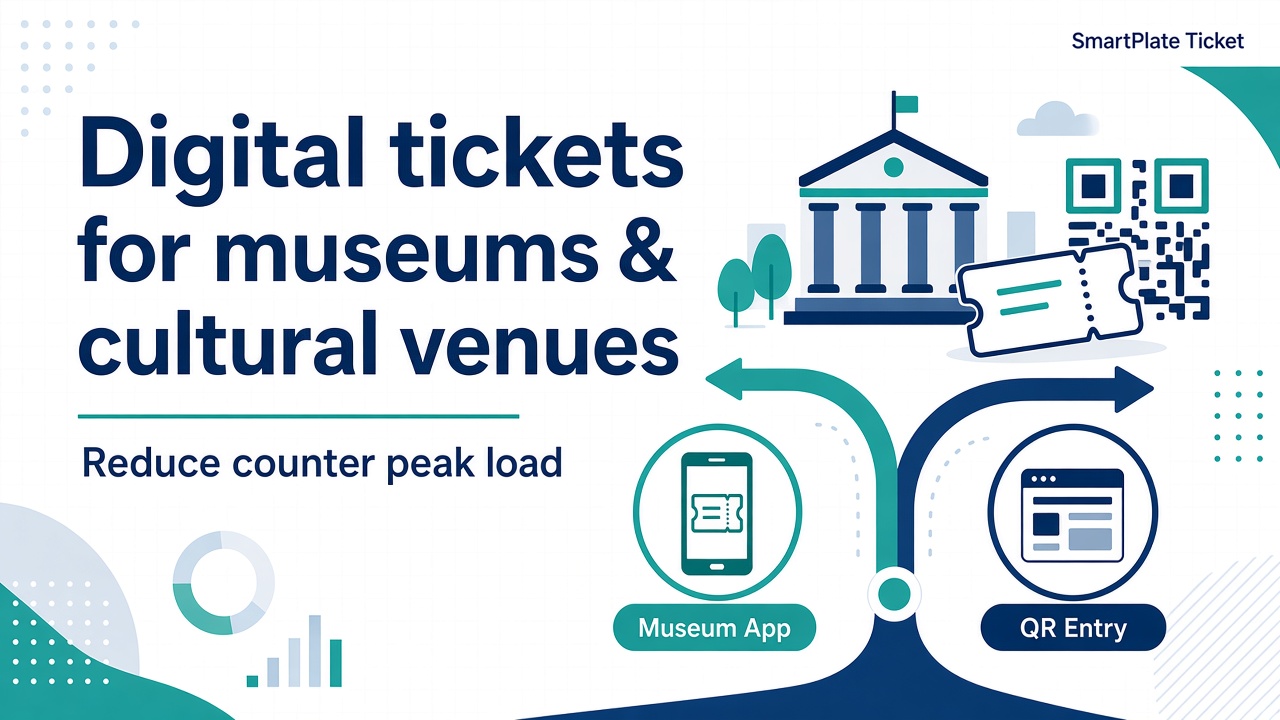
This article focuses on admission tickets for museums, art museums, and science centers sold on the web and through multiple channels, including QR code entry validation. Programs where shopping vouchers and store payment are the main municipal goal use different ticket and contract assumptions. For single events centered on assigned seating or lotteries, use Comparing event ticket sales systems to quote event-oriented ticket sales vendors against each other.
Recommended order: 1. Counter peak issues → 2. Ticket types (presale, day-of, annual) → 3. Operating unit (one show / one venue / multi-venue) → 4. Double-operation risks → 5. Pre-quote checklist. Scope: museum/gallery/science center admission (not voucher-only or seated events). Below follows this order.
Counter peaks | What cultural venues run into
Cultural facilities often face these burdens before and after ticket digitalization:
- Day-of counters — cash, cards, and discount checks; queues on special-exhibition openers and holidays
- Mixed ticket types — permanent, special exhibitions, annual passes, groups; inconsistent guidance at the counter
- Entry validation — paper stubs, stamps, visual checks; device count and staff placement
- Reporting — reconciling sales and admissions by channel; audit and subsidy reporting when applicable
Ticket digitalization does not always remove lines by web presales alone. Summarize who sells which ticket types where, and who validates entry on-site on one worksheet before splitting quotes—then counter and web roles become easier to assign.
Presales, day-of, and annual passes | Points by ticket type
Facility admission combines presales and day-of sales differently by program. Before comparing vendors, align points by ticket type in the table below.
| Ticket type | On-site decisions | Digitalization focus |
|---|---|---|
| Permanent / general admission | Keep day-of counters or web-only | Timed entry, re-entry rules |
| Special exhibitions | Period, capacity, time slots | Presale ratio vs day-of, sold-out messaging |
| Annual passes / membership | Renewal cycle, ID checks | Member data integration, counter renewals |
| Groups / schools | Invoice payment, batch entry check | Separate proxy purchase from entry validation |
When presales include refund rules and entry validation device operations, document them together with the ticket-type table.
Splitting quotes | Decide the operating unit first
In cultural venue ticket digitalization, public examples show that before vendor comparison, teams split on what to treat as one product, one contract, and one data flow. Facility teams often use these three operating units (a guide for splitting quotes, not an exclusive market taxonomy).
Table scrolls horizontally
| Operating unit | Scope in contract and data | On-site picture | Often quoted separately |
|---|---|---|---|
| Single run / limited period | One exhibition, program, or event with clear dates and venue | Presales → entry validation → settlement for that run | Mixing permanent admission or annual pass renewal into the same single-run quote |
| One facility / year-round | Same facility permanent, timed, passes, day-of counter | Official web plus counter, gate, vending machines; revenue to the facility | Adding OTA or agency channels without clarifying requirements |
| Multi-facility / common pass | Multi-site or tourism admission in one product | Common QR and rules; sales via travel sites | Replacing single-site counter ops with a common pass alone |
Tip: Channel count alone does not pick the unit. Single run is a product-design unit; many channels is where that product is sold—different questions.
One facility, year-round | Official web and on-site together
Products that link official facility web with counters, vending machines, and gates are commonly described for museums and aquariums. Timed entry and annual-pass lotteries stay within one facility’s catalog, which fits many cultural venue ticket digitalization counter-reduction goals.
Single run / limited period | Presales per exhibition
Playguide services (advance ticket distribution for performances and events; e+ is a common example) assume web presales per event. Special exhibitions at museums often appear as individual events. Keeping permanent admission and passes on facility systems while quoting special shows as single runs is a common two-system pattern.
Multi-facility common passes | Tourism admission
Multi-site admission products are sold through playguide or facility distribution platforms as separate products. The design focus is valid venues and settlement, not gate scripts alone—split contracts and data from one facility, year-round quotes.
Where dual operations creep in at the same venue
When requesting quotes or RFPs, watch for these operational mismatches:
| Mismatch | Typical pattern | How to align |
|---|---|---|
| Special show as single run, permanent on facility stack | Playguide presales for shows, counters only for permanent | Split contracts, revenue, and entry data by run vs facility core |
| Common pass mixed with single-site tickets | Tourism pass rules differ from day-of counter tickets | Fix product definitions and entry validation reader rules in a table |
| Channels added before gates | OTA connected but gate procedures unchanged | Decide entry validation steps and offline fallback first |
Pre-quote check | Map your operating unit
Step 1 — six items
- Operating unit — which row in the table is primary (if several, one-line priority)
- Ticket scope — permanent / special / pass / groups
- Contract entity — facility operator vs municipality or tourism association
- Channels — official web only, or playguide, OTA, travel agencies
- Entry validation — gate count, paper fallback, re-entry
- Settlement — one facility vs multiple operators or sites
Step 2 — quote buckets
| Step 1 answer | Quote bucket | Next action |
|---|---|---|
| Primary: one facility, year-round | Facility web + on-site admission from two or more vendors of the same type | Attach ticket table, gate count, existing vending machines |
| Primary: single run (seating / lottery) | Comparing event ticket sales systems for event-oriented ticket sales | Separate facility-core quote; align dates and data feeds |
| Primary: multi-facility common pass | Split distribution / common pass and entry validation per site | Fix settlement recipients and valid venue list first |
| Municipality-branded wallet beyond admission | Do not mix with single-facility quotes; integrated requirements on a separate sheet | Evaluate SmartPlate Ticket and similar program-dedicated sites in a separate track |
See features and rollout examples on the service site.
FAQ
Q1. Where should cultural venue ticket digitalization start?
Decide the ticket-type table and operating unit (single run / one facility year-round / multi-facility) first. If one facility, year-round is primary, start with facility web and on-site integration quotes; if only special shows use event presales, treat them as single runs with separate quotes.
Q2. Will web presales alone shorten counter lines?
Higher presales often lighten day-of counters, but passes, discounts, and inquiries remain. Without entry validation devices and staff procedures, gate queues can become the bottleneck.
Q3. Can special shows use playguide presales while permanent stays on another system?
Publicly, presales per run and year-round facility admission are different product scopes. Split contracts and operations so revenue, entry data, and counter steps do not duplicate, then summarize visitor guidance (which QR where) on one sheet.
Summary
1. Memo counter/gate load. 2. Fix ticket-type table. 3. Pick operating unit for quotes. 4. List double-run risks (permanent vs special / OTA). 5. Send like-with-like quotes with checklist and one visitor QR guide.
Related service
SmartPlate Ticket | Program-dedicated ticket platform
When municipality or DMO branding requires multiple ticket types with different rules on one public site and wallet, this is an option. When one facility admission alone closes contract and settlement, start with one facility, year-round quotes first.